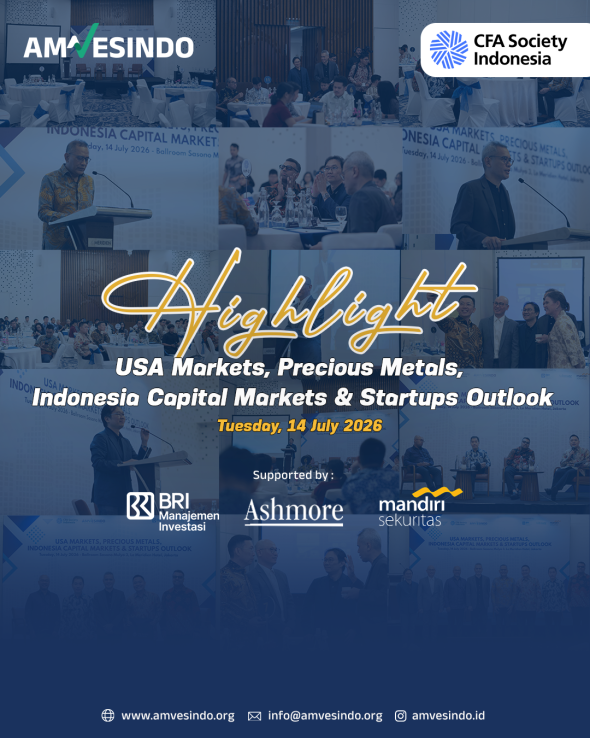
JAKARTA – As the initial hype of 2026 settles into a data-driven reality, investors in Jakarta are navigating a complex economic trinity: a fluctuating Rupiah, a maturing US bull market, and an unprecedented “forever-rally” in precious metals. To synchronize these global quantitative signals with local fundamental realities, a high-level strategic briefing was held on Tuesday, July 14, 2026, at the Le Meridien Hotel, Jakarta.
Organized by CFA Society Indonesia in collaboration with Amvesindo, and proudly supported by BRI Manajemen Investasi, Ashmore Asset Management, and Mandiri Sekuritas, the half-day conference themed “USA Markets, Precious Metals, Indonesia Capital Markets & Startups Outlook” gathered top market practitioners, analysts, and academics to provide an in-depth analysis of cross-asset market trends.
Setting the Stage for a Data-Driven Second Half The event commenced with an Opening Speech by Triono Soedirdjo, CFA, Vice President of CFA Society Indonesia, setting a collaborative tone for the day. This was immediately followed by a Keynote Speech from Dr. Eddi Danusaputro, Chairman of Amvesindo, who emphasized the importance of aligning global macroeconomic shifts with domestic investment strategies, particularly within the venture ecosystem.
Decoding Global Markets and Quantamental Analysis The first main session featured Wong Kon How from CME Group, presenting on “Quantamental Analysis of Precious Metals & US Markets.” He addressed a critical market anomaly: historically, precious metals and US equities move in opposite directions. However, 2026 has seen gold, silver, and US indices reaching record highs simultaneously. By leveraging Quantamental Analysis—the convergence of big data charting and fundamental insights—Wong decoded whether these inverse relationships are fracturing or intact.
The Startup Reality Check: Capital Efficiency as the New Filter Representing the core voice of the venture industry, Andreas Surya, Vice Chairman II of Amvesindo, delivered a highly anticipated presentation titled “Startups Investment Outlook in Indonesia.”
Andreas offered a stark, pragmatic view of the current funding cycle from its 2021 peak to today. He outlined a shifting paradigm where capital efficiency has replaced aggressive growth as the primary investment filter. Key takeaways from his thesis included:
-
The Repricing Reality: The “tech winter” has already repriced market entries, but it has not yet established clear pricing norms.
-
The New Underwriting Edge: Investors must now rely on rigorous underwriting tools rather than a blanket “buy” mentality.
-
Evaluate Like a Credit Analyst: Investors are urged to assess startups with the scrutiny of a credit analyst, looking past mere growth stories to evaluate fundamental financial health and unit economics.
Panel Discussion: The Indonesian Capital Market Outlook The conference concluded with a robust panel discussion dissecting the domestic capital market, moderated by Gary Tejakusuma, CFA, CIO of Sun Life Indonesia. The panel provided diverse, expert perspectives on the second half of the year:
-
Anil Kumar, CFA (Deputy CIO, Ashmore Asset Management) shared insights on Fixed Income opportunities and risks.
-
Herman Tjahjadi, CFA (CIO, BRI Manajemen Investasi) provided a comprehensive view of the Equity market.
-
Rangga Cipta (Chief Economist, Mandiri Sekuritas) delivered a macro perspective on Indonesia’s broader economic trajectory.
By bridging global market analytics with the localized realities of the startup and capital markets, the conference successfully equipped stakeholders with the tools needed to mitigate risks and capitalize on emerging opportunities in late 2026.