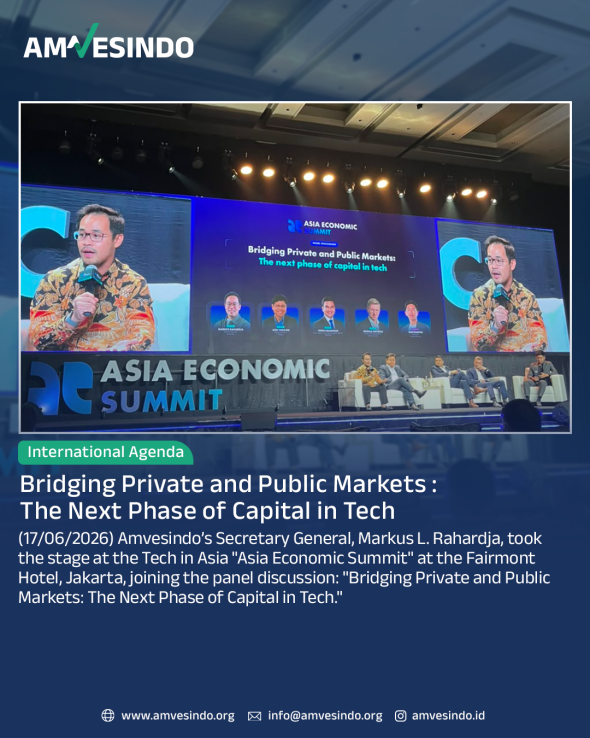
JAKARTA – As Southeast Asia’s tech narrative transitions from aggressive growth to sustainable profitability, the conversation surrounding exits and public market readiness has never been more critical. On Wednesday, June 17, 2026, the Indonesian Venture Capital Association for Startups (Amvesindo) took the stage to address these industry shifts at the Tech in Asia “Asia Economic Summit” held at the Fairmont Hotel, Jakarta.
Representing Amvesindo, Secretary General Markus L. Rahardja joined as a key panelist in a high-profile session titled “Bridging Private and Public Markets: The Next Phase of Capital in Tech.”
A Reality Check on the Ecosystem The panel featured distinguished voices from across the global and regional tech investment landscape:
-
Markus L. Rahardja, Secretary General of Amvesindo
-
Yoke Kee Ang, Managing Director of Pedigree
-
Hiren Krishnani, Senior Director, Investor Relations & IPO, ASEAN Nasdaq
-
Michael Gryseels, Founder & Managing Partner of Antares Ventures
The session kicked off with a critical reality check: Are founders, investors, regulators, and public markets actually aligned on what success looks like today?
During his segment, Markus provided an in-depth analysis from the center of Indonesia’s venture ecosystem. He addressed the current misalignments between founders, Venture Capitals (VCs), Limited Partners (LPs), and regulators. A major point of discussion was the shifting industry bottleneck, specifically analyzing whether the ecosystem has officially moved from a “funding problem” to an “exit problem.”
Redefining Success and Readiness in Indonesia Markus also shed light on the changing dynamics of investor expectations, highlighting the behaviors that investors are rewarding today compared to five years ago. Taking a closer look at the local landscape, he evaluated Indonesia’s level of readiness for public markets, breaking down whether the primary hurdles stem from regulatory frameworks, investor education, market liquidity, or analyst coverage.
Looking ahead to the next five years, Markus shared strategic recommendations on where policymakers and ecosystem builders must focus their efforts to stimulate more exit opportunities for local startups.
The panel concluded with a forward-looking vision for 2030, challenging the speakers to identify the single most important decision that needs to be made in the next three years to transform Southeast Asia into a truly mature and investable tech market.