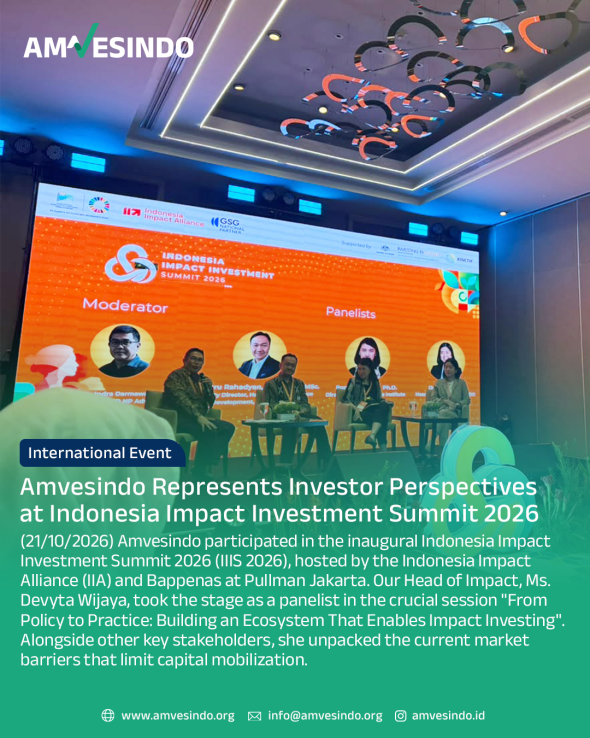
JAKARTA – Indonesia’s impact investment ecosystem is gaining significant momentum. To strengthen the ecosystem’s capacity to mobilize more diverse capital, the Indonesian Venture Capital and Startup Association (Amvesindo) actively participated in the inaugural Indonesia Impact Investment Summit 2026 (IIIS 2026).
Held on Wednesday, October 21, 2026, at the Pullman Jakarta Ballroom, the summit convened under the theme “Mobilising Capital, Accelerating Impact”. This national-scale intervention was hosted by the Indonesia Impact Alliance (IIA) in collaboration with the Ministry of National Development Planning (Bappenas), and supported by Investing in Women and KINETIK.
Moving from Policy Theory to Capital Flow Reality
Representing Amvesindo, Head of Impact Devyta Wijaya served as a panelist in Breakout Session Wave 1 Track 2, titled “From Policy to Practice: Building an Ecosystem That Enables Impact Investing”. The 75-minute session was designed to identify the shifts needed to strengthen Indonesia’s enabling environment for impact investment and enable more capital to contribute to the Sustainable Development Goals (SDGs).
Devyta Wijaya participated in the first round of the discussion, “Where Does Capital Still Face Friction?”, moderated by Dr. Indra Darmawan, Advisor at the Ministry of Investment. This segment examined Indonesia’s current sustainable finance environment from both regulatory and market perspectives.
Addressing the Friction in Capital Mobilization
Sharing her perspective as a fund manager and investor, Devyta Wijaya highlighted where impact investments most often break between capital mandates and real market opportunities. She also addressed the single most significant market barrier limiting capital mobilization today and the practical actions needed to remove it.
These insights are critical, considering that Indonesian MSMEs face an estimated USD 52 billion annual financing gap. Furthermore, there are significant underserved opportunities in the “missing middle”—enterprises whose financing needs are too large for microfinance yet too small for commercial banks.
Through this strategic participation, Amvesindo remains committed to bridging the gap between capital supply and market opportunities, ensuring investments not only generate financial returns but also drive measurable social and environmental impact.